

How the Father Wound Destroys Relationships (Without You Knowing)
The Wound You Carry Into Every Relationship
Most women do not walk into a new relationship thinking about their father. They are thinking about the person in front of them. The chemistry. The hope. The possibility.
But the father wound (or “daddy issues”) does not wait to be invited. It arrives before you do. It shapes who you find attractive, what you will tolerate, how much you give, how quickly you leave, and how long you stay when you should go.
Understanding how the father wound affects your relationships is not about making excuses. It is about finally understanding why the same dynamics keep showing up no matter who you choose.
Why You Keep Choosing the Wrong Partners
The human brain is not drawn to what is healthy. It is drawn to what is familiar. If your father was emotionally unavailable, you will feel an almost magnetic pull toward emotionally unavailable partners. Not because you are self-destructive, but because your nervous system recognizes the pattern as home.
The Guest daughter often chases. She gravitates toward partners who run hot and cold because the cycle of pursuit, connection, withdrawal, and hope mirrors exactly what love felt like growing up. She mistakes the anxiety of uncertainty for the electricity of passion.
The Ghost daughter may choose men who mirror her father's absence in different ways: emotionally checked out, physically unavailable, more committed to work or substances or their own needs than to her.
The Monster daughter often oscillates between controlling partners who feel dangerous and men she can dominate, trying to rewrite either the powerlessness or the threat of her childhood.
Why Healthy Love Feels Wrong
This is one of the most painful and confusing effects of the father wound: when someone genuinely healthy and available shows up, it does not feel like love. It feels flat. Boring. Like something must be wrong with them.
That is not a character flaw. It is a calibration issue. Your nervous system was calibrated to a specific frequency of love, and a healthy partner is broadcasting on a different signal. The discomfort you feel is not incompatibility. It is unfamiliarity.
Learning to tolerate, and eventually desire, healthy love is one of the central tasks of healing the father wound.
The Overgiving Pattern
Many women with a father wound become extraordinary givers in relationships. They cook, they plan, they support, they show up. They give so much that the relationship becomes an asymmetry: they pour in, the partner receives.
This overgiving is not generosity. It is a strategy. Somewhere in the subconscious is the belief that if she gives enough, she will finally be chosen. That her value must be demonstrated. That love is earned through effort.
But love cannot be earned. It can only be given. And until the father wound is addressed, this distinction remains theoretical.
Friendships and the Father Wound
The father wound does not stop at romance. In friendships, it often shows up as:
• Tolerating one-sided friendships where you give and they take
• Difficulty expressing needs for fear of burdening people
• Attracting wounded people you can help, because being needed feels safer than being loved
• Ending friendships suddenly when trust is broken, because betrayal confirms what you always feared
You Can Break the Pattern
The relationship patterns created by the father wound are not permanent. They are learned. And what was learned can be unlearned, or more precisely, replaced with something truer.
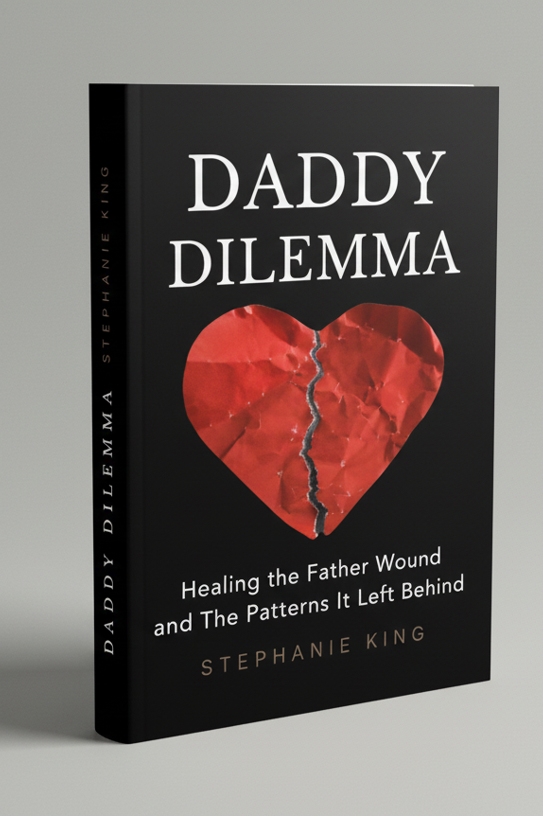
Daddy Dilemma walks you through exactly how to identify, interrupt, and replace these patterns.
Ready to go deeper?
Daddy Dilemma: Healing the Father Wound and the Patterns It Left Behind is available now on Amazon in paperback, hardcover, and Kindle.
